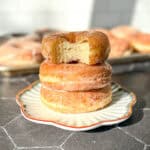
90 Minute Classic Glazed Donuts
Make soft, fluffy Classic Glazed Donuts with a crackly vanilla glaze in just 90 minutes. No overnight rise, no drive-thru - just bakery-worthy donuts any day of the week.
Servings: 12 donuts
Calories: 333kcal
Equipment
Ingredients
For the donuts
- 3 ½ cups all-purpose flour plus 1 tablespoon (8 g) if needed
- ¼ cup granulated sugar
- 4 teaspoons instant yeast
- 1 ¾ teaspoons kosher salt half as much if using table salt
- ¾ cup whole milk
- ¼ cup water
- 1 large egg
- 4 tablespoons unsalted butter melted and slightly cooled
- Neutral oil for frying
For the vanilla glaze
- 3 cups powdered sugar
- 6 tablespoons whole milk
- 1 ½ teaspoons vanilla extract
- Pinch kosher salt
Instructions
- Make sure you have a warm place for rising. Dough rises best at 75 to 78°F. If your kitchen is cool, turn your oven on to 300°F for about 2 minutes, then turn it off. You only want a warm, draft-free space, not a hot oven.
- Prepare the parchment. Cut parchment paper into individual squares large enough to hold one donut. Arrange them on a sheet pan so each shaped donut can rest on its own piece of parchment.
- In the bowl of a stand mixer, whisk together the all-purpose flour, sugar, yeast, and salt.
- Combine the milk and water and warm to between 100°F and 110°F. Whisk in the egg and melted butter. Pour the wet ingredients into the dry ingredients. Mix by hand until a shaggy dough forms.
- Place on the stand mixer and use the dough hook to work the dough on medium-low speed for 3 minutes. Check the dough. It should begin pulling away from the sides of the bowl. If it is still sticking heavily to the bowl, add 1 tablespoon of all-purpose flour.
- Continue kneading for another 3 minutes, or until the dough is smooth, elastic, and pulling away from the sides of the bowl. The bottom may still stick slightly.
- Shape the dough into a ball and place in a lightly greased bowl. Cover and let rise in a warm place for about 15 minutes. It does not need to double, but it should look noticeably puffier.
- Shape the donuts. Turn the dough onto a lightly floured work surface and gently roll to about ½ inch thick. Cut with a 3 to 3 ½-inch donut cutter and place each donut on its own parchment square.
- Gather the scraps and gently press them together. If the dough springs back and is difficult to roll, cover it and let it rest for 5 minutes before rolling again. Cut the remaining donuts and donut holes.
- Second rise. Cover loosely and let rise in a warm place for about 20 minutes, or until noticeably puffy and light. During the final 10 minutes of proofing, pour about 2 inches of neutral oil into a heavy-bottomed pot or Dutch oven. Heat to 350°F.
- Make the glaze. Whisk the powdered sugar, milk, vanilla, and salt together in a wide, shallow bowl until completely smooth. It should be thin enough to easily coat the donuts while still leaving a visible glaze.
- Fry the first six donuts. Use the individual parchment pieces to easily carry each donut to the oil. Hold the parchment close to the surface of the oil and gently slide the donut in (It's OK if the parchment paper falls into the oil. Use a pair of tongs to remove it.)
- Fry 2 to 3 donuts at a time, without crowding the pot, for about 45 to 60 seconds on each side, or until evenly golden brown. I like to turn mine with long chopsticks, but you can also use your spider strainer or slotted spoon.
- Glaze the first batch. Once the first six donuts have cooled for about 2 to 3 minutes but are still warm, dip them into the glaze, turning to coat. Again, I use my chopsticks to do this. Let the excess glaze drip off, then return them to the wire rack to dry. Maintain the oil temperature as close to 350°F as possible. Transfer the fried donuts to a wire rack set over a sheet pan.
- Fry and glaze the remaining donuts in the same way. Fry the donut holes for about 60 to 90 seconds. They won't want to flip over, so use your spider strainer to gently dunk them under the oil until done.
- Let all of the donuts rest on the rack for about 10 to 15 minutes, or until the glaze has set into a thin, slightly crackly coating.
Notes
Dough consistency: This is a soft dough and should be slightly tacky. After 3 minutes of kneading, add 1 tablespoon of flour only if the dough is still sticking heavily to the sides of the mixer bowl.
Rerolling scraps: After gathering the scraps, the gluten may make the dough spring back. Cover and rest it for about 5 minutes, then roll again.
Individual parchment squares: Placing each shaped donut on its own piece of parchment makes the delicate risen donuts much easier to transfer to the hot oil without stretching or deflating them.
Work in two batches: Fry about six donuts, glaze them while they're still warm, and return them to the rack to set while you fry the second batch. This gives you a much nicer glaze than waiting until every donut has been fried.
Oil temperature: Keep the oil as close to 350°F as possible. If it's too cool, the donuts can absorb excess oil. If it's too hot, they'll brown before the centers are fully cooked.
Best the same day: Like most fried yeast donuts, these have their best texture within a few hours of frying. Store leftovers loosely covered at room temperature for up to 2 days. Microwave for 10 to 15 seconds to just take the chill off.
Nutrition
Calories: 333kcal | Carbohydrates: 65g | Protein: 7g | Fat: 6g | Saturated Fat: 3g | Polyunsaturated Fat: 0.4g | Monounsaturated Fat: 1g | Trans Fat: 0.2g | Cholesterol: 28mg | Sodium: 19mg | Potassium: 120mg | Fiber: 2g | Sugar: 35g | Vitamin A: 176IU | Vitamin C: 0.01mg | Calcium: 39mg | Iron: 2mg
